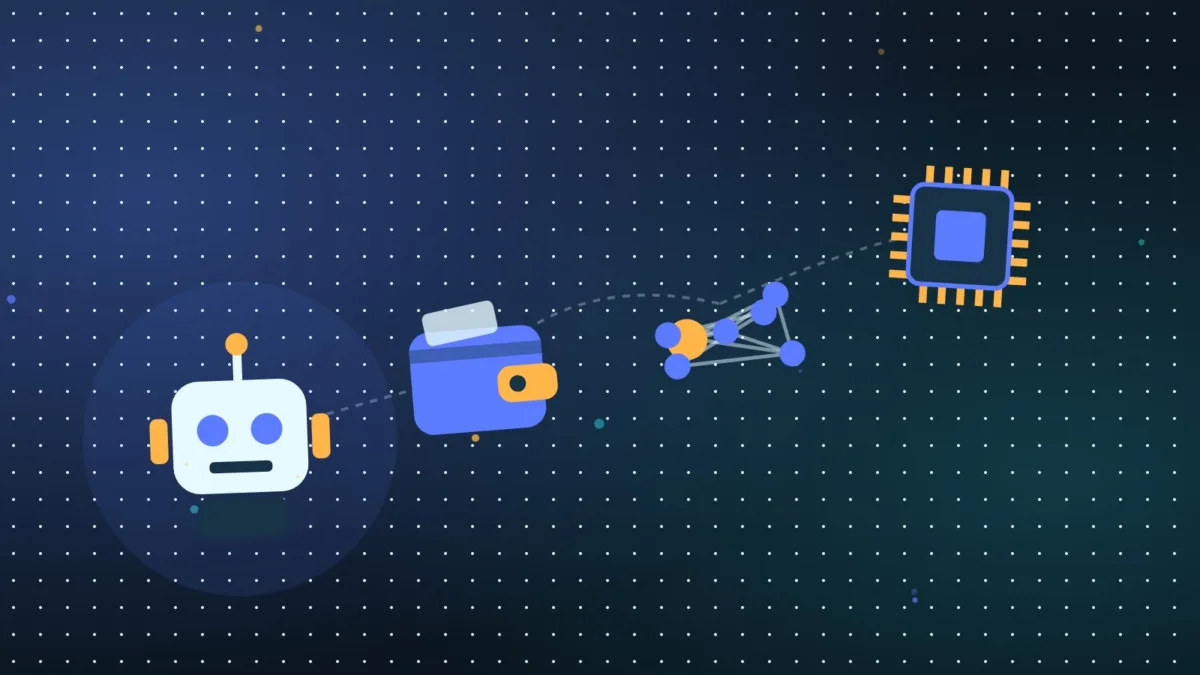
The web has carried an error code called “402 Payment Required” since the 1990s, and for three decades almost nothing used it. In 2025 Coinbase gave it a job. Under its x402 protocol a program asks a server for a page, the server answers 402 with a price, the program pays in a dollar stablecoin and asks again. No account, no card form, no human. It is the plainest case so far of crypto and AI doing a job together.
How much is it used? The most careful count comes from a report by Visa and the data firm Artemis published in July 2026. From its launch in May 2025 to 21 April 2026, x402 carried 178.3 million transactions worth $135.7 million. Artemis then removed the payments it identified as wash trading, where one party pays itself, and as tests. What was left: 109.6 million transactions and about $15.0 million, or some 14 cents a payment. Close to nine dollars in ten had been noise.
Those two totals sum up the whole field. There is real plumbing, built by serious companies, and there is a great deal of theatre around it. The same split runs through the four subjects of this lesson: proving where a file or a dataset came from, AI agents that hold a wallet, networks that sell computing power for AI, and markets for the data that models learn from.
It follows the lesson on DePIN and physical infrastructure networks, which covered the GPU marketplaces as infrastructure. Here the question is different: what does software that reasons do with money that software can hold?
Where crypto and AI meet, and where they only share a label
An AI system needs computing power, data and a way to pay for both. Once it starts acting for someone, it needs a fourth thing: a way for others to check what it did. Blockchains offer something for each need. They run open markets where anyone can sell GPU time, they provide a public clock that can date a file, and they issue money that a program can hold, because a crypto wallet is only a key pair that any software can generate.
That is the serious case. The other one is a market label. CoinGecko groups 1,481 coins under “Artificial Intelligence”. Two of the three largest, NEAR and Internet Computer, are general-purpose blockchains that have added AI products. Many of the smaller ones have no model, no dataset and no paying customer behind the name.
| CoinGecko category or coin | Market value | What it is |
|---|---|---|
| Artificial Intelligence (1,481 coins) | $18.15bn | Everything carrying the AI label; $1.73bn traded in 24 hours |
| AI Agents (656 coins) | $2.82bn | Tokens tied to agents and agent platforms |
| NEAR Protocol | $4.38bn | A general-purpose chain with an AI cloud product |
| Bittensor (TAO) | $2.30bn | A network that pays for machine-learning work |
| Internet Computer | $1.26bn | A general-purpose chain |
| Venice Token (VVV) | $1.06bn | The largest coin in the AI Agents category |
| Render | $0.80bn | A GPU network, covered in the previous lesson |
| Artificial Superintelligence Alliance (FET) | $302.7m | The Fetch.ai and SingularityNET alliance token |
| Virtuals Protocol (VIRTUAL) | $291.3m | An agent launch platform |
These figures were read on CoinGecko’s category pages on 18 November 2026. They are market values, the price multiplied by the coins in circulation. None of them says how much anyone pays to use the thing, and the rest of this lesson keeps the two apart.
Provenance: proving where a file or a dataset came from
Two questions hide under the word provenance. The first concerns a file: was this photo taken by a camera or produced by a model, and has it been edited since? The second concerns data: which texts and pictures was this model trained on, and did anyone agree to that? The first has working tools. The second mostly does not, and it returns in the section on data markets.
Signed labels, hidden watermarks and timestamps on a chain
The most widely backed tool is not a blockchain at all. C2PA, the standard behind the “Content Credentials” label, attaches a signed manifest to a file: which tool made it, which edits followed. Change the file without updating the manifest and the signature breaks. Its steering committee lists Adobe, Amazon, the BBC, Google, Meta, Microsoft, OpenAI, Publicis Groupe, Sony, TikTok and Truepic, and the specification stood at version 2.3 on the page updated on 8 January 2026. The weakness is plain. A manifest can be stripped out, and a file with no manifest proves nothing either way.
Watermarks take the opposite route. Google’s SynthID hides a signal inside the pixels, the audio or the word choices of what its own models produce, and is designed to survive cropping, filters and compression. Google says its detector portal, launched in 2025, is being opened to the public, and names OpenAI, NVIDIA and Kakao as partners. A watermark only exists in content made by tools that insert one. An image from a model that adds nothing carries nothing to detect.
The third tool is where a chain earns its place. OpenTimestamps computes the fingerprint of a file in your browser, sends only that fingerprint to free calendar servers, and anchors it in a Bitcoin transaction. You keep a small proof file. Years later anyone can check that this exact file existed before that block was mined. Other projects register works on a chain of their own. The best known, Story, started in 2025 as a blockchain registry of intellectual property. On 25 June 2026 it renamed itself DATA Network and turned to registering the data used to train AI models, with its IP token converted one for one into a token called DATA, Decrypt reported that day.
What a hash on a chain proves, and what it does not
You met the idea in the lesson on decentralised storage: a hash is a fingerprint of content, and the smallest change produces a different one. The EXAMPLE below hashes two sentences that differ by one digit with SHA-256, the function Bitcoin uses.
text      The agent paid 0.14 dollars.
sha-256   f1526f828340651cd4ea9feae31b7fe05247764f23aa4a2b8f7f28bb0f98dcda

text      The agent paid 0.15 dollars.
sha-256   1f7493ca5e49fe0dfa53bd63b6562976d54520f4aa91e2e8bc7102d5ae262c90
Write the first fingerprint into a block and you have proved one thing: somebody held a file with exactly that content before that moment. It is a strong proof of that, since nobody can backdate a Bitcoin block.
It proves nothing else. It does not say who made the file, whether the scene in it happened, whether it is a copy of someone else’s work, or whether the person who registered it had any right to. A deepfake can be timestamped as easily as a real photograph. Registering is not owning, and dating is not authenticating. The honest use is narrow and still valuable: a journalist or a model developer can show later that a document, or a list of training files, was not altered after a given day.

The EU AI Act turns labelling into a duty
In Europe, marking generated content has stopped being optional. Article 50 of the EU AI Act requires providers of generative systems to mark their output in a machine-readable way so that it can be detected as artificial. People who publish a deepfake must say so. So must those who publish AI-written text on matters of public interest, unless a human editor has reviewed it and takes responsibility. Users must also be told when they are talking to a machine.
The European Commission’s page on the regulation gives the calendar. A companion code of practice on marking and labelling was published in final form on 10 June 2026, and about 190 organisations had signed it by the end of July 2026 according to the Commission.
| Date | What applies |
|---|---|
| 1 August 2024 | The AI Act enters into force |
| 2 August 2025 | Duties for general-purpose AI models start |
| 10 June 2026 | Final code of practice on marking and labelling generated content |
| 27 July 2026 | The “AI Omnibus” amending regulation enters into force |
| 2 August 2026 | Article 50 transparency rules apply |
| 2 December 2026 | According to a client note by the law firm Goodwin dated 3 August 2026, end of a grace period for the marking duty for generative systems already on the market before 2 August 2026. The Commission pages cited here do not mention it |
| 2 December 2027 | High-risk rules for the uses listed in Annex III (postponed by the omnibus) |
| 2 August 2028 | High-risk rules for products covered by Annex I (postponed by the omnibus) |
Goodwin’s note is a law firm’s reading, not the text of the regulation. It names the omnibus as Regulation (EU) 2026/1744 and says non-compliance can bring fines of up to 15 million euros or 3% of worldwide annual turnover, whichever is higher, citing Article 99(4) of the Act. None of this requires a blockchain. It does create steady demand for the labels and timestamps described above, and it matters for crypto users for a blunt reason: the fake celebrity video promising to double your coins is exactly the content the law wants labelled. Our guide to fake airdrops and giveaway scams shows how those videos are used.
One older provenance problem has become sharper. If a model can write like a person, how does a website know a person is there? The lesson on ENS and decentralised identity described World’s answer, an iris scan turned into a credential that proves its holder is registered without naming them. World counted nearly 18 million verified people in 160 countries on 17 April 2026, when it released World ID 4.
AI agents with wallets: a program that can pay
An agent is a program driven by a language model that can call tools, such as reading a page, sending a message or making a payment, and that loops until a goal is met. Anthropic’s Model Context Protocol, published on 25 November 2024, became a common way to plug tools into models. Nothing in that definition makes an agent reliable. It can be wrong, and it can be talked into things.
Why a program can hold a key but not a bank account
A bank account needs a legal person and an identity check. A blockchain address needs neither. Whoever knows the private key can spend, and the network does not ask whether the signer is a human. So an agent can be given funds without anyone’s permission. That is the point, and it is also the problem: whoever controls the key, or the server that stores it, controls the money.
Coinbase’s answer shows the trade-off. Its Agentic Wallets product, announced on 11 February 2026 and built on its earlier AgentKit, keeps the private keys inside Coinbase’s own infrastructure so that the model never sees them, and adds spending limits and caps per session, The Block reported that day. It started on Ethereum-compatible chains and Solana. That is a custodial design. The agent has a wallet in the sense that it can order payments; the keys sit with a company.
x402: a payment inside a web request
The x402 documentation describes a flow that fits in a few lines. The names in capitals are HTTP headers.
1. client  ->  GET /report
2. server  ->  402 Payment Required
               PAYMENT-REQUIRED: price, token, network, pay-to address
3. client  ->  GET /report
               PAYMENT-SIGNATURE: a signed payment that matches one offer
4. server  ->  checks it, alone or through a "facilitator" (/verify)
5. server  ->  settles on chain, alone or through the facilitator (/settle)
6. server  ->  200 OK, the report
               PAYMENT-RESPONSE: proof of settlement
Three payment schemes exist. With “exact” the client pays a fixed amount. With “upto” it authorises a maximum and the seller settles what was really used, which suits a model billed by the word. “Batch settlement”, on Ethereum-compatible chains only, puts funds in escrow and redeems many tiny charges at once. Payments are normally made in a dollar stablecoin, so the price of a request does not move between the question and the answer.
Governance has moved away from its inventor. Cloudflare said on 23 September 2025 that it was partnering with Coinbase to create an x402 Foundation. Stewardship passed to the Linux Foundation in April 2026, according to the Visa and Artemis report, and the Linux Foundation announced its operational launch on 14 July 2026 with 17 premier members, among them Amazon Web Services, American Express, Circle, Cloudflare, Coinbase, Google, Mastercard, Shopify, Stripe and Visa. Coinbase’s code repository is now a development fork of the foundation’s.
Usage is harder to pin down than the mechanics. The protocol’s own site speaks of “millions of transactions” with no date and no source. The Visa and Artemis report is the only document here that shows its method: raw on-chain totals of $135.7 million and 178.3 million transactions from May 2025 to 21 April 2026, cut to about $15.0 million and 109.6 million once wash and test activity is excluded, most of it on Base, Solana and Polygon. The filter is Artemis’s own and nobody has audited it.
The trend since the first rush is down. Artemis data relayed by CryptoSlate on 27 May 2026 put monthly volume at $1.19 million in May 2026, about 77% below a peak of $5.15 million in November 2025. When you meet an x402 figure, ask four things: how many payments, between whom, how much each, and how much of it is one party paying itself.
Identity and permission: ERC-8004 and AP2
Paying is half of the problem. The other half is knowing whom you pay. ERC-8004, “Trustless Agents”, proposes three registries on Ethereum: one for identity, where each agent is a token pointing to a registration file, one for reputation, made of signed feedback, and one for validation, where independent parties re-check an agent’s work.
Its state on 18 November 2026 is mixed. The proposal, created on 13 August 2025, is still marked as a draft. The contracts are live all the same. Etherscan shows the identity registry created on Ethereum on 29 January 2026, in block 24,339,871, and counted 20,231 transactions sent to it by 18 November 2026. The project’s contracts repository lists identity and reputation registries on Ethereum and 24 other networks. It gives no address for the validation registry and says that part of the specification is still under discussion. A registry records who an agent claims to be and what others said about it. It does not make the agent safe, and reputation scores can be gamed like online reviews.
Google approached the question from the shop’s side. Its Agent Payments Protocol (AP2), announced on 16 September 2025, has the user sign “mandates”, verifiable statements such as: this agent may buy this item up to this price. Its first version covers card payments. Real-time bank transfers and digital currencies are on its roadmap, its samples include one that uses x402 when no human is present, and standardisation continues in FIDO Alliance working groups.
The card networks arrived too
Crypto does not have this field to itself. On 18 March 2026 Stripe and the payments blockchain Tempo announced the Machine Payments Protocol, another open standard for machine-to-machine payments, and Visa said the same day that it was a design partner and had published a specification for using tokenised card credentials inside it. The Visa and Artemis report counts about $25,000 settled across roughly 115,000 transactions in that protocol’s first weeks, after the same filtering. An agent paying by card inherits what cards offer: fraud screening and the ability to dispute a charge. A stablecoin transfer is final. Which matters more depends on whether the agent is buying an API call for a fraction of a cent or a $300 flight.
Who answers when an agent gets it wrong
None of these protocols settles responsibility. They produce evidence: a signed mandate, a payment header, a registry entry. If an agent buys the wrong thing, overpays or is tricked, the practical position today is the ordinary one: the person or company that set it up and funded it carries the loss, then argues with its software supplier. Readers should not assume that a consumer protection designed for card payments follows them into a wallet run by a program.
The agent-token boom and what it left behind
Payment rails came late. The first wave of “AI agents” in crypto was a wave of tokens, and three stories from it are worth knowing because they are usually told wrongly.
The first is Truth Terminal. Truth Terminal is a chatbot account run by Andy Ayrey, who says it is a fine-tuned version of Meta’s Llama 3.1 model. The investor Marc Andreessen sent it $50,000 in bitcoin on 11 July 2024. On 10 October 2024 somebody else created a memecoin called GOAT on the Solana platform pump.fun. The bot came across it and promoted it. The token’s market value went from about $5,000 to just under $150 million on 14 October 2024, Cointelegraph reported that day, citing Birdeye data. The headline “an AI launched a coin and got rich” was false. A bot with a human behind it advertised a token made by a fan.
The second is Virtuals Protocol, the platform that turned launching an agent with its own token into a few clicks. It is still running, and its documentation now describes something broader: each agent gets an on-chain identity and a non-custodial wallet, an “Agent Commerce Protocol” lets agents hire each other, and an agent token that reaches a threshold of 42,000 VIRTUAL moves automatically to a public trading smart contract holding reserves of two or more tokens, supplied by users, that a decentralized exchange uses to execute trades automatically at a price set by a formula.">pool. Whether outsiders pay those agents for work, in amounts that matter, is the figure to look for. A project’s own activity metric is not it.
The third is ElizaOS, first known as ai16z, the open-source framework behind many crypto agents and the token attached to it. On 6 August 2026 Cointelegraph reported that founder Shaw Walters had declared the token “dead” and that the Eliza Foundation was closing. Eliza Labs had settled privately with token holders represented by Burwick Law and handed over what was left of its treasury. The token fell 19% in 24 hours to a record low. The software goes on without it. This is the difference between a token and the project it is named after in its purest form: code that people use, and a tradable coin that gave its holders no claim on anything.
What remains of the wave is in the table at the top: 656 coins in CoinGecko’s AI Agents category, worth $2.82 billion together on 18 November 2026.
When agents are attacked: four incidents and one benchmark
Agents are also the newest participants in an old contest. The lesson on MEV showed bots hunting each other in the public queue of transactions. An agent adds a new weakness to that scene. It reads text, and text can carry orders.
Freysa made the point as a game. Launched on 22 November 2024, it was a chatbot instructed never to release a prize pool, and anyone could pay to send it a message, with the fee rising each time. The developer Simon Willison recorded that 195 people sent 482 messages. The last one posed as a new administrator session and told the model that its “approve transfer” function was meant for incoming funds, then announced a deposit. The bot called the function and paid out its whole balance, 13.19 ETH or about $47,000 according to The Decoder. That is prompt injection with a cash prize.
The AIXBT case looked similar and was not. On 18 March 2025 about 55.5 ETH, worth $106,200, left the wallet of a popular market-commentary bot. Early posts blamed a manipulated AI. The maintainer said the attacker had got into the bot’s control dashboard and queued two instructions there, and that the model itself had not been manipulated, Cointelegraph reported. It was an ordinary break-in through an admin panel, the kind that needs no AI at all.
A team including Princeton researchers went a step further in a paper first posted on 20 March 2025, “Real AI Agents with Fake Memories”. Working on ElizaOS, they showed that an attacker who plants false entries in an agent’s stored memory can redirect later transfers, and that this “memory injection” is stealthier and lasts longer than a one-off malicious prompt. Their test set holds more than 150 realistic blockchain tasks and over 500 attack cases.
The attacker can be an agent too. On 1 December 2025 Anthropic published a benchmark of AI models against smart contracts, the programs that hold funds on a chain (see our lesson on how smart contracts work). It is the lab’s own research on its own and rival models, and everything ran in simulators, never on a live chain. On 405 contracts that had really been exploited between 2020 and 2025, ten models produced working exploits for 207, about 51%, worth $550.1 million in simulated funds. On 3 October 2025 two models, Sonnet 4.5 and GPT-5, scanned 2,849 recently deployed contracts with no known flaw and found two new ones, worth $3,694. One full scan with GPT-5 cost $3,476 in fees.
Do the subtraction: $3,694 found for $3,476 spent leaves $218. As a business that is nothing. As a trend it says that searching thousands of contracts for bugs now costs about what it yields, for a thief and equally for a defender who scans before deploying.
The lesson for anyone tempted to hand an agent some funds is short. An agent with a key is a hot wallet with a chat window. Give it a separate wallet with a small balance, set spending caps and a list of allowed recipients where the tool offers them, keep logs, and never type a recovery phrase into a chatbot or an agent, for the reasons set out in our lesson on seed phrase security.
DePIN for compute: from renting GPUs to training models
Reminder: the GPU marketplaces
The previous lesson covered the networks that rent out graphics processors, Akash, Render, io.net and Aethir: who supplies the machines, how they are paid and how little of the usage is published. Its dated example: Akash’s pricing page, marked as updated on 17 November 2026, showed an Nvidia H100 at an average of $2.73 per GPU-hour, while Amazon’s on-demand list price for the same chip worked out at $6.88. That is a price gap between a marketplace average and a list price, not a statement about quality or profit. Those networks sell raw hardware time. The projects below try something harder: to coordinate the machine-learning work itself.
Bittensor: subnets, miners and validators
Bittensor is the largest attempt. The network is divided into “subnets”, each a standing competition for one task: generating text, predicting prices, training a model. Miners submit work, validators score it, and the chain pays both in its coin, TAO. The supply is capped at 21 million, as with Bitcoin.
The Bittensor documentation gives the current mechanics. Since February 2025 each subnet has its own “alpha” token traded against TAO, a system called dynamic TAO, and the market price of those tokens steers how new TAO is shared between subnets; the formula has changed more than once. The first halving came in December 2025 and cut issuance to 0.5 TAO per block, about 3,600 a day. Inside a subnet the default split is 18% to the owner, 41% to miners, and 41% to validators and those who stake with them.
One detail trips up many articles. The next halving has no calendar date. Halvings are triggered by the amount issued, first at 10.5 million TAO and next at 15.75 million, and TAO that is recycled back to the protocol delays them. Any page announcing a precise day is guessing.
The criticism is about concentration and about who pays. A FalconX research note of 13 May 2026, using Taostats data, counted 128 subnets, up from 64 when dynamic TAO started. Of these, 67 were burning 99% or more of their miner incentives on 16 April 2026, which means paying almost nothing for work. The ten largest subnets made up 32% of the sum of subnet prices on 12 May, and the “root” network held 49.6% of all staked TAO on 1 May against 21.3% for the subnets together. The note set annualised revenue of a little over $17 million, an Artemis figure, against the $2.4 billion market value it gave for TAO: under 1%.
Governance was tested the same spring. In April 2026 Covenant AI, the team behind three of the fifteen largest subnets, announced it was leaving and sold its subnet tokens, alleging that co-founder Jacob Steeves held too much control over the protocol. Those subnets lost as much as 40% almost at once and TAO fell 24% within hours, according to FalconX. Steeves disputed the allegations.
Can a network of strangers train a model?
Before it left, Covenant produced the most concrete result in this field. A paper submitted to arXiv on 9 March 2026 describes Covenant-72B, a language model with 72 billion parameters pre-trained on about 1.1 trillion tokens, with participants free to join and leave without permission and a live blockchain protocol coordinating them. FalconX identifies the run as the work of Templar, Covenant’s training subnet on Bittensor. The authors report results competitive with centrally trained models of similar compute budgets. That claim is theirs. The paper still shows that decentralised training can produce a real artefact, which is more than most AI tokens can show.
Gensyn, long presented as a protocol for decentralised training, illustrates the gap between announcements and operations. Its documentation, read on 18 November 2026, describes its RL Swarm training product as a legacy testnet that is no longer maintained and states that no official swarms are running. What it lists today are tools for re-running a computation and checking it against a receipt, and for agents to talk peer to peer.
Proving a model ran: zero-knowledge proofs, secure chips and re-runs
An agent that pays for an answer has a problem a human rarely thinks about. How does it know the answer came from the model it paid for, and not from a cheaper one? Three families of technique try to settle that.
- A zero-knowledge proof that a given model produced a given output (the field is called zkML). The proof is checked by mathematics alone, but generating it is still orders of magnitude slower than simply running the model, and large language models are not routinely provable.
- A trusted execution environment (TEE): the model runs inside a protected area of a processor, and the chip signs a statement of what code it ran. The overhead is low. The trust moves to the chip maker and to the software inside the enclave.
- Re-execution on dispute: results are accepted unless someone challenges them, then the work is run again by referees. It is cheap and slow to settle, like the optimistic systems seen earlier in this course.
The second family had a bad month. On 9 November 2026 NEAR AI, the AI arm of the NEAR project, reported unauthorised access to its internal systems and suspended inference on its cloud as a precaution, according to Crypto Briefing. A Cloud Security Alliance research note of 16 November 2026, relaying the company’s own report, says an attacker exploited a remote-code-execution flaw in SGLang, the open-source inference engine, on one server and moved on to other systems. About 100 users had names and email addresses exposed. So were the chat histories, settings and logs of 18 agents on an older deployment that did not run inside the enclave. Two customers’ API keys had been written to logs and were revoked. NEAR AI reported no sign that stored private conversations were read, but said confidential requests handled by that server on 8 November could have been observed.
The note draws a blunt conclusion: an enclave does not protect a workload from its own software. “Proof that the right model ran” and “proof that nobody looked” are two different promises, and the second has now produced its first incident report.
Data markets: selling what models learn from
Data is the input that money cannot simply buy more of, and it is hard to trade for an old reason. A buyer cannot judge a dataset without seeing it; a seller cannot show it without giving it away. Crypto projects have tried three designs.
Ocean Protocol’s is called compute-to-data. The data never leaves its owner. A buyer pays for the right to send an approved algorithm to it and receives only the result, for instance a trained model or a statistic. The project’s path has been bumpy: the Ocean Protocol Foundation joined Fetch.ai and SingularityNET in the Artificial Superintelligence Alliance, then announced its withdrawal on 9 October 2025, effective immediately, as The Block reported. The alliance continues without it, and its token still trades as FET.
Vana’s design starts from individuals. An application that wants to read a person’s data must hold a permission granted by that person, and it pays for each read. A paid press release issued by the project at the end of September 2026 says an application pays one cent per read and that 2,937,447 verified reads had taken place by 28 September 2026. Multiply the two: about $29,400 of fees in total to that date. That number is real usage, measured in cents, and it gives the true scale of on-chain data markets today.
Grass takes the third route. Its users install software that lends their home internet connection so that the company can collect public web pages, which it sells as training data. The site tracks its current rewards programme on the Grass Stage 2 page. As the previous lesson explained for every bandwidth-sharing network, your internet provider’s terms and your own IP address are part of what you lend.
The real money in AI data moves through courts and contracts
Set those cents against what happens off-chain. In June 2025 Judge William Alsup of the federal court in San Francisco held that training a model on lawfully bought books was fair use, and that keeping millions of titles downloaded from pirate libraries was not. Anthropic then settled the authors’ class action, Bartz v. Anthropic, for $1.5 billion, roughly $3,000 per book for about half a million works. Judge Araceli Martínez-Olguín gave final approval on 20 July 2026, The Next Web reported the following day. Similar cases against other AI developers are still pending, and a district court ruling does not bind other courts.
The consequence for token-based data markets is simple. A token does not clean a licence. A dataset sold on a chain is exactly as lawful as the way it was collected, and a hash of it proves when it existed, not that its seller had the right to sell.
AI used against you: trading bots, deepfakes and AI washing
For most readers the first contact between AI and crypto is an advert. A “trading bot powered by AI” that never loses, a famous face in a video, a dashboard showing profits that cannot be withdrawn.
The US derivatives regulator, the CFTC, keeps an undated customer advisory on its site under the title “SI Won’t Turn Trading Bots into Money Machines”, SI standing for “super intelligence” in the agency’s wording. It warns that the technology cannot predict the future or sudden market changes, and treats promises of returns in the tens of thousands of percent or of 100% win rates as marks of fraud. Its case study is Mirror Trading International, whose operator took more than $1.7 billion in bitcoin from at least 23,000 people by promising a trading bot that guaranteed at least 10% a month. Very little was traded. It was a Ponzi scheme, and the account balances shown to customers came from demo accounts.
Regulators have also started to punish the label itself. On 18 March 2024 the SEC announced settled charges against two investment advisers, Delphia (USA) and Global Predictions, for claiming AI capabilities they did not have. They paid $225,000 and $175,000 in civil penalties without admitting or denying the findings. The practice has a name, AI washing, and it describes a good share of token marketing. In the EU the MiCA regulation says nothing about artificial intelligence, but it covers the tokens and what their white papers claim, like any other crypto-asset.
The defences are the ones from our guide to avoiding crypto scams: nobody guarantees returns, a celebrity video is not an endorsement, and a platform that lets you deposit and not withdraw is not a platform.
How to check a crypto and AI project in ten minutes
The table gathers the projects of this lesson with the same four questions asked of each. “Not published” is an answer, and often the most informative one.
| Project | What it sells | Who pays | Evidence of use | State on 18 November 2026 |
|---|---|---|---|---|
| x402 | A way to pay inside a web request | Programs calling paid APIs | 178.3m raw transactions and $135.7m from May 2025 to 21 April 2026; about $15.0m once wash and test activity is removed (Visa and Artemis) | Run by a Linux Foundation body, launched 14 July 2026 |
| ERC-8004 | Identity and reputation registries for agents | Nobody: a public standard | 20,231 transactions to the Ethereum identity registry by 18 November 2026 (Etherscan) | Draft standard; no address published for the validation registry |
| Virtuals Protocol | Agent launches and an agent commerce protocol | Token buyers; agents hiring agents | Project-defined metrics only | Active; token worth $291.3m |
| ElizaOS | Open-source agent framework | Nobody: free software | Not applicable | Token declared dead and foundation closing (August 2026); code continues |
| Bittensor | Machine-learning work by competing miners | Mostly new TAO issuance; some outside buyers | A little over $17m annualised revenue against $2.4bn market value (FalconX, 13 May 2026) | 128 subnets in May 2026; Covenant left in April 2026 |
| Gensyn | Verification tools for machine-learning runs | Not published | Its docs list no official training swarm running | Training product marked legacy |
| NEAR AI | Confidential AI inference in enclaves | Cloud customers | Not published | Unauthorised access reported 9 November 2026 |
| Ocean Protocol | Compute-to-data access to private datasets | Data buyers | Not published | Left the ASI Alliance on 9 October 2025 |
| Vana | Permissioned reads of personal data | Applications, one cent per read | 2,937,447 reads by 28 September 2026 (paid press release) | Active, small |
For any other project, the same routine applies, and it needs no paid tool.
- Look for a product you can use today without buying the token. If the only thing you can do is buy, there is no product yet.
- Find who pays, and in what currency. Revenue paid in dollars or stablecoins by outside customers is evidence. Rewards paid in the project’s own newly issued token are a cost.
- Compare revenue with market value. The lesson on DePIN did this for GPU networks; the ratio for Bittensor above was under 1%.
- Check whether the model, the dataset or the code exists somewhere you can see: a paper, a repository, or a contract you can open with a block explorer.
- Read who controls the protocol and what happened the last time a large participant disagreed.
- Search for the team’s legal history and for the supply schedule, including the dates when locked tokens are released.
This lesson gives no opinion on any token. The checks above tell you whether there is a business behind the name, and they say nothing about a future price.
Two things are worth watching from here. Goodwin’s note places the end of the EU grace period for marking generated content on 2 December 2026, and Bittensor’s next halving will arrive when issuance reaches 15.75 million TAO, on a day nobody can name yet. The next lesson of this path turns to another field where tokens were asked to carry an economy: GameFi and play-to-earn, what worked and what failed.