





Metrics
About the project
The Midnight crypto network is a layer 1 blockchain for smart contracts that keep their data private, incubated by Input Output, the company founded by Charles Hoskinson, who also founded Cardano. Its token, NIGHT, has a fixed supply of 24 billion and works in an unusual way: it is never spent on fees. Holding it generates DUST, a private resource that cannot be transferred and that pays for transactions. The genesis block is dated 17 March 2026, and Midnight’s tokenomics whitepaper gives 30 March 2026 as the day the mainnet launched.
Eight months on, the network is still in what its roadmap calls the federated phase. Thirteen chosen operators produce the blocks, the Midnight Foundation runs two of those nodes and pays the others, and the Foundation and its subsidiary Midnight TGE Ltd. together hold 50.25% of all NIGHT with no lockup, a concentration the whitepaper itself says “warrants express disclosure”.
What is Midnight crypto? Private smart contracts next to Cardano
The project calls its approach “rational privacy”. A user keeps sensitive data on their own device and sends the chain a zero-knowledge proof, a short piece of cryptography showing that a statement about that data is true without showing the data. A lender could check that a borrower earns above a threshold without seeing the payslip; a bank could show a regulator that a rule was followed without publishing its client list. The documentation splits every contract in two: a public state stored on the chain, and a private state that stays encrypted with the user. The proofs are zk-SNARKs: 128 bytes each whatever the computation, according to the documentation, and checked by validators in milliseconds.
The second idea is selective disclosure. Privacy is the default for the data a contract marks as private, and the owner can reveal a specific fact to a specific party, such as an auditor or a tax office. That is the commercial pitch: Midnight is aimed at companies and institutions that cannot put client data on a public ledger and cannot use a tool that hides everything from supervisors either.
This makes Midnight a different product from Zcash or Monero, the two best-known privacy coins. NIGHT itself is not private. The documentation classes it as an unshielded token, meaning its balances and transfers are visible, like bitcoin’s. The privacy sits in the contracts, in shielded tokens that developers can issue, and in DUST, the fee resource.
Compact, a contract language based on TypeScript
Writing zero-knowledge circuits by hand is specialist work. Midnight’s answer is Compact, a language modelled on TypeScript whose compiler turns a contract into the circuits needed to prove it ran correctly. The open-source version of the project is hosted by Linux Foundation Decentralized Trust under the name Minokawa, according to Midnight’s FAQ. Under the contracts, the ledger uses unspent outputs, as Bitcoin and Cardano do, while contracts can keep account-style state as on Ethereum; our guide to the UTXO and account models explains the difference.
A partner chain, not a chain built on Cardano
The network is its own layer 1. Its overview page says it is built with the Polkadot SDK, the toolkit formerly called Substrate, and that its runtime includes components from Cardano’s partner-chains framework. Blocks are produced with AURA, a proof-of-authority algorithm in which known validators take turns, and finalised with GRANDPA. The link with Cardano is still close: NIGHT was created as a Cardano native asset on 25 November 2025, a copy of the supply exists on Midnight, and a cross-chain protocol is designed so that a token is never spendable on both chains at once. CoinDesk corrected its launch report on 31 March 2026 to say that Midnight is a partner chain of Cardano and not built on it.
How the NIGHT token generates DUST, the resource that pays the fees
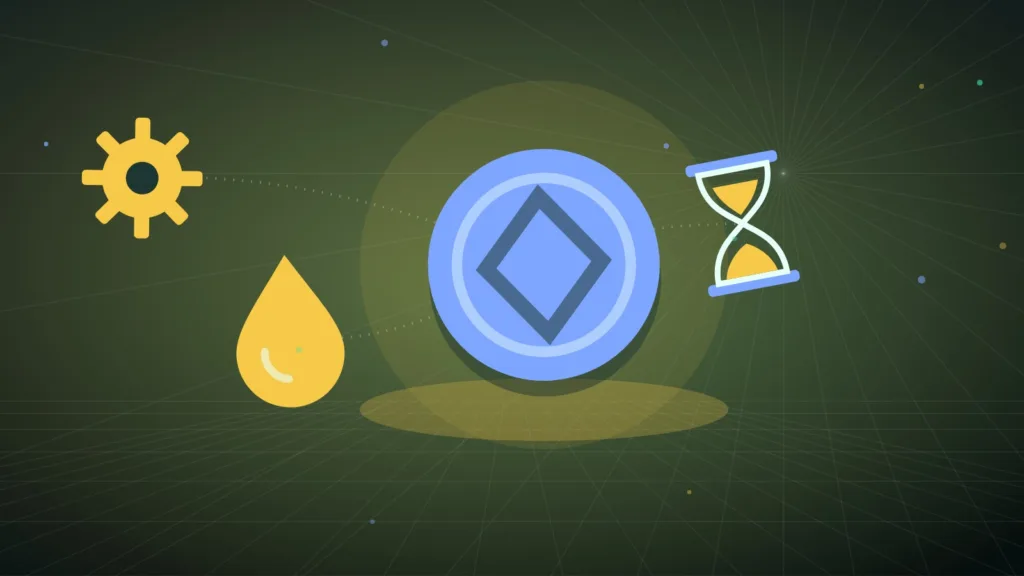
On most chains, a transaction burns or transfers a little of the native coin. On Midnight, the coin stays where it is. A holder registers a DUST address, and from then on each NIGHT held produces DUST at a fixed rate until it reaches a ceiling. Fees are paid in DUST only. The whitepaper sums up the effect: whoever holds enough NIGHT can transact on Midnight without paying anything more, for as long as they keep holding.
The DUST architecture page of the documentation gives the constants written into the ledger, and notes that they override older figures in the whitepaper.
| Parameter | Value in the ledger (docs read on 18 November 2026) |
|---|---|
| Smallest unit of NIGHT | 1 NIGHT = 1,000,000 Stars |
| Smallest unit of DUST | 1 DUST = 1,000,000,000,000,000 Specks |
| Generation rate | 8,267 Specks per Star per second, about 0.71 DUST per NIGHT per day |
| Ceiling | 5 DUST per NIGHT |
| Time to reach the ceiling | About 604,815 seconds, roughly one week, whatever the amount held |
| Example | 100 NIGHT generate about 71 DUST a day and stop at 500 DUST |
DUST behaves like a battery more than like a coin. It charges while the NIGHT behind it sits still, and it drains once that NIGHT moves: when the backing tokens are spent, the DUST they generated decays to zero at the same speed it built up. If only part of a NIGHT holding is spent, the change comes back as a new output that starts charging from scratch. DUST cannot be sent to another user, and unlike NIGHT it is a shielded resource.
Holders who keep NIGHT on Cardano can generate DUST too. They register a Cardano reward address together with a DUST key, and Midnight watches the Cardano chain to credit the matching DUST. Fees themselves are set by the protocol according to the size of the transaction and how busy the network is; the FAQ says Midnight does not use fee-market bidding, so users do not outbid each other for block space.
The model opens the door to someone else paying. An application that holds NIGHT can sponsor its users’ fees, so that a customer never has to own a token. Midnight’s September 2026 network report says Gero wallet version 2.7.1, released on 16 September, lets one wallet pay the DUST fees of another wallet in the same account, and the August report describes a Capacity Exchange by Sundae Labs that lets users of supported applications settle fees in the USDM stablecoin. The whitepaper goes further on paper, with leasing of DUST generation to another address and “Babel stations” that would accept other assets or fiat money. Those remain plans.
DUST is not guaranteed to last either. The documentation states that it is not persistent: the protocol can redistribute it at a hard fork and reserves the right to change the allocation rules. That is what happened on 6 November 2026, when the Ledger 9 upgrade reset DUST on mainnet and then restored registered Cardano-side holders to their full ceiling. NIGHT balances were untouched.
Who controls Midnight: 13 federated nodes and a 15-seat committee
Four names come up. Input Output incubated the project. Shielded Technologies, an engineering company spun out of Input Output, built the protocol and the Compact language; the release announcing the Foundation on 13 May 2025 named Eran Barak as its chief executive. The Midnight Foundation, announced the same day and led by its president Fahmi Syed, a former chief financial officer of Parity Technologies, is in charge of the ecosystem and of the path to decentralisation. Midnight TGE Ltd., a subsidiary of the Foundation, issued and distributed the token. Neither the whitepaper nor the Foundation’s launch release states where the Foundation is incorporated.
The money came from the founder. CoinDesk reported on 30 March 2026 that Hoskinson had put roughly $200 million of his own funds into Midnight and that the project was not built on venture capital. The figure is CoinDesk’s; Midnight’s launch announcement gives none. In the launch announcement of 29 March 2026, Hoskinson put the ambition in one line: “Midnight gives us our identity and privacy back.”
The block producers
Blocks are produced by a closed list. The whitepaper, in the version dated May 2026, counts thirteen federated node operators, of which two are run by the Midnight Foundation and the rest by companies the Foundation “contracts and pays”. The launch announcement named nine of them: Worldpay, Bullish, MoneyGram, Pairpoint by Vodafone, eToro, AlphaTON Capital, Google Cloud, Blockdaemon and Shielded Technologies. There are no block rewards during this phase, according to the FAQ.
Well-known companies are a reasonable guard against an operator misbehaving in secret. They are not decentralisation. Thirteen operators chosen and paid by one foundation can halt the chain, censor a transaction or agree a change of rules among themselves, and a user has no vote and no way to run a block-producing node.
The committee that can change the protocol
Upgrades are decided by a governance committee that signs with a multisig, a wallet needing several approvals. The whitepaper describes two bodies: a Technical Authority of nine members, which judges a proposal on technical grounds, and a Council of six, which approves it on behalf of the ecosystem. An on-chain action needs at least six of the nine and four of the six. Their remit is wide: the list of federated block producers, the membership of the committee itself, version upgrades, hard forks and core parameters such as block size. The Foundation is a member of the committee. The names of the people or entities holding the fifteen seats have not been published in the whitepaper or the FAQ.
The Ledger 9 upgrade shows the process at work. Midnight’s post of 6 November 2026 says the hard fork went straight to mainnet without the usual trial period on the Preprod test network, a route it reserves for releases that carry security fixes. In October, all mainnet validators moved to node version 1.0.400, which the October 2026 network report calls a targeted security patch.
The node’s code repository shows what such patches fix. Its security advisories page carries two notices rated high severity as of 18 November 2026. The first, published on 29 September 2026, describes a caching flaw that could make nodes disagree on whether a block was valid and leave new nodes unable to sync; it was fixed in version 1.0.300. The second, published on 14 November 2026, describes how a transaction sent by anyone could exhaust the memory of nodes running version 1.0.4; the fix is in version 2.1.101, whose release is dated 8 November.
NIGHT holders are promised a say later. The whitepaper says on-chain voting on proposals and on the Treasury is “intended” once decentralised governance has been built, and gives no date.
NIGHT tokenomics: a 24 billion total supply, half of it with two related entities
The total supply of NIGHT is fixed at 24 billion. No new tokens can be minted; what will enter circulation later comes out of a Reserve created at the start. The whitepaper publishes the allocation as it stood on 18 May 2026.
| Allocation | NIGHT | Share of supply | Status (whitepaper, as at 18 May 2026) |
|---|---|---|---|
| Midnight Foundation | 8.4 billion | 35% | Unlocked since 10 December 2025, no protocol lockup |
| Reserve | 6.0 billion | 25% | Locked until permissionless block production starts, then paid out only as block rewards |
| Glacier Drop and Scavenger Mine (claimed) | About 4.547 billion | 18.9475% | Thawing in four 25% tranches over 360 days from 10 December 2025 |
| Midnight TGE Ltd. | 3.66 billion | 15.25% | Unlocked since 10 December 2025; reserved for commercial partnerships and liquidity, unused tokens to return to the Reserve |
| On-chain Treasury | 1.2 billion | 5% | Locked until on-chain governance exists |
| Lost-and-Found | About 192.6 million | 0.8025% | Locked until a later claim phase, open for four years |
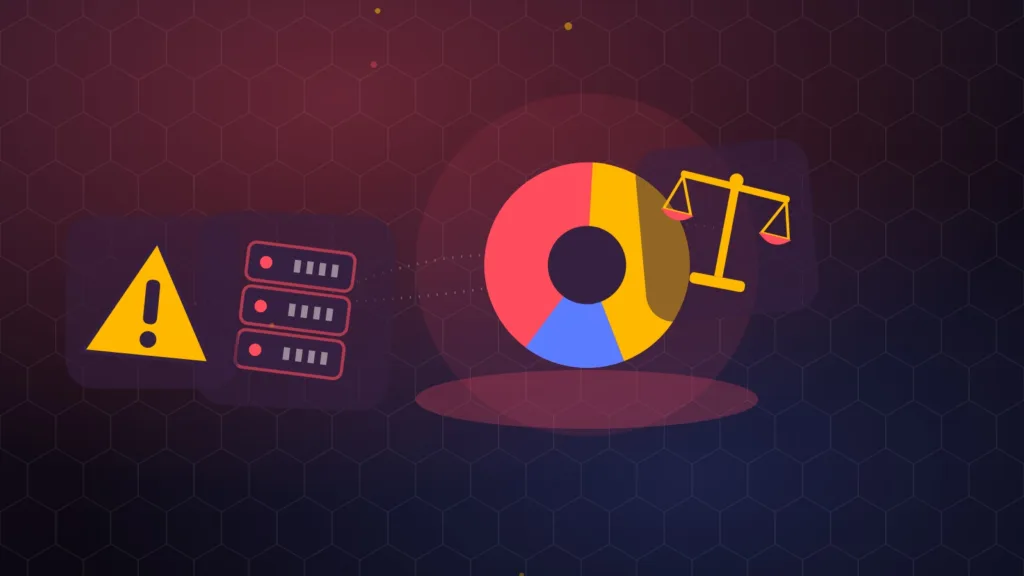
The first and fourth lines are the ones to read twice. The Foundation and Midnight TGE Ltd. hold 12.06 billion NIGHT between them, 50.25% of everything that will ever exist, and both allocations have been freely transferable since 10 December 2025. The whitepaper does not hide it. It states that the Foundation has discretion over how it transfers and uses its tokens and that it “may take decisions or actions that conflict with the interests of one or more other holders of NIGHT”. The two entities say they intend to publish information on material transfers “from time to time”, and the same paragraph calls this “a statement of present intent only”, not an obligation.
In practice, the largest potential source of NIGHT reaching the market is not a dated token unlock that anyone can put in a calendar. It is a decision two related organisations can take at any time. The holders can be checked on a Cardano explorer, and the Foundation keeps a list matching wallets to allocations on midnight.gd.
The Reserve works differently. It stays locked until outside block producers are admitted, and then releases a fixed percentage of whatever remains at each block. Rewards therefore shrink block after block, and the whitepaper estimates that the Reserve would last for hundreds of years. Part of each reward depends on how full the block is, with the unearned share going to the Treasury. None of this is active yet, since there are no block rewards in the federated phase.
What does a holder get? Today, DUST, which is to say the capacity to use the network or to sponsor others. Later, if the plans are carried out, a vote. NIGHT pays no yield and Midnight has announced no buyback. On the legal side, the whitepaper says the MiCA white paper for NIGHT classifies the token as an “other crypto-asset”, meaning neither a stablecoin category nor a utility token in the sense of the European regulation, with Midnight TGE Ltd. as issuer, a company that by the same document “does not control, operate or manage the Midnight network”.
Glacier Drop, Scavenger Mine and the thaw that ends on 4 December 2026
NIGHT was not sold. It was given away in two phases in 2025. The Glacier Drop, open from 5 August to 20 October, let self-custody holders of ADA, BTC, ETH, SOL, XRP, BNB, AVAX and BAT claim tokens based on a snapshot of 11 June 2025. The Scavenger Mine, which ran until 19 November, handed out 1 billion NIGHT to more than 8 million addresses, according to Midnight’s launch guide. In total about 4.547 billion NIGHT were claimed, and the token launched on Cardano on 4 December 2025.
Claimed tokens were frozen and thaw in four equal parts, 90 days apart, with a first date drawn at random for each claim. The last tranche thaws by 4 December 2026, after which the claim portal stays open for a 90-day grace period. Nothing arrives by itself: each tranche has to be redeemed by its owner, as our page on the final NIGHT thaw and redemption deadline explains step by step. Redemptions were suspended once, from 28 June to 9 July 2026, after a security incident at a third-party Cardano wallet; Midnight said its own systems were not affected.
What runs on Midnight in November 2026
For its first six months, the mainnet ran what the launch announcement called an initial deployment period in a protected environment. That changed on 28 September 2026, when Midnight opened contract deployment to any developer. The Ledger 9 hard fork of 6 November then added functions that builders coming from Ethereum expect: one contract can call another in the same transaction and identify its caller, contracts can emit public events that wallets and explorers read, and the ledger accepts ECDSA signatures, the kind used by Bitcoin and Ethereum, next to Schnorr signatures. Existing balances and contracts carried over; applications had to move to version 5 of the Midnight.js library.
The most concrete use so far comes from a bank. On 17 November 2026, Monument, a UK bank authorised by the Prudential Regulation Authority, began offering a fixed-term savings account whose balance is mirrored by a token on Midnight. Midnight says up to £250 million of deposits can be represented in this first phase. That is a ceiling, the amount actually deposited has not been published, and the token is a record in a wallet the bank controls that savers cannot move. Our report on Monument’s tokenized deposit on Midnight has the terms.
Around it, the list is made of early products and pilots. Ascend has launched a perpetuals exchange and an order-book spot exchange. Sig Network’s Nightmode lets a Midnight user make deposits, Uniswap swaps and Aave supply and withdrawals on Ethereum, with privacy as the selling point; its integration was extended to Solana in October and a TRON version is scheduled for December 2026, according to the October network report. A hackathon in South Korea drew 38 teams. Midnight Passport, an identity product, and the “Midnight City” vision shown at TOKEN2049 in Singapore are demonstrations and roadmap items.
Measuring real activity is harder. DefiLlama, the usual reference for value locked in applications, lists neither a Midnight chain nor a Midnight protocol as of 18 November 2026 (the “Morpho Midnight” entry on that site is an unrelated lending product on Ethereum and Base). The one public count comes from Midnight Explorer, a community-built explorer that Midnight’s documentation says has not been audited. It showed 1,019,963 cumulative mainnet transactions on 27 October 2026, with 47,714 on 26 October against 128 on 27 September, according to crypto.news, which reported that Input Output relayed the milestone on X the same day. The jump follows the opening of contract deployment. Neither post gave the number of active addresses or separated contract calls from registrations and other system transactions, and a transaction count says nothing about the value involved.
Developers also lost a convenience in October. Midnight shut down the indexer and RPC endpoints it hosted for mainnet and Preprod on 9 October 2026; applications now have to go through the provider Blockfrost or run their own. As for the token, Midnight’s August 2026 report said NIGHT had become available on S.BLOX, a Sony group company, for buyers in Japan.
Audits: the ledger, the circuits and the token contracts, but not the node
Midnight publishes its audit reports on a dedicated page of its documentation. Six are listed as of 18 November 2026.
- zkSecurity reviewed the standard circuit library (Poseidon hashing, big integers, JSON and Base64 parsing) in a report dated 11 April 2025.
- Tweag, part of Modus Create, audited the NIGHT token and Glacier Drop contracts in August 2025.
- Least Authority audited the ledger, including the Zswap shielded-transfer protocol and DUST, in a final report dated 19 December 2025.
- TxPipe audited the upgradable Cardano contracts that hold the Reserve, in a report dated 8 January 2026.
- Least Authority audited the SHA-3 (Keccak) circuits, report dated 23 February 2026.
- Least Authority audited the Midnight.js library that applications use, report dated 11 March 2026.
The gaps matter as much as the list. No report on that page covers the node software or the consensus layer. The whitepaper says Least Authority’s work also took in the node, the indexer and the wallet tooling, and that Mandiant assessed the Foundation’s production systems, which it notes is not a code audit; those reports are not among the six published. The ledger audit predates Ledger 9, which replaced the format of every proof and verification key in November 2026. The code is public, under the midnightntwrk organisation on GitHub and mostly under the Apache 2.0 licence, so outside researchers can read it.
Roadmap: Cardano stake pool operators come next, without a date
Midnight names its four phases after Hawaiian moon phases. Hilo, the token launch, is done. Kūkolu, the federated mainnet, is the current one. Mōhalu, which the whitepaper tags “target 2026”, is the phase in which Cardano stake pool operators progressively become Midnight block producers. Hua, “late 2026 and beyond”, covers the on-chain market for DUST capacity, a DeFi kernel, the Passport identity programme and links to other chains.
With six weeks left in the year, Midnight has announced no date for admitting stake pool operators. The October 2026 report sets out seven work tracks running to the first quarter of 2027, among them confidential financial infrastructure, identity tools, scaling and post-quantum proof systems, and mentions a staged move from AURA to the BABE consensus protocol without a timetable. The whitepaper labels all of its roadmap as forward-looking, and the FAQ warns it may be revised.
The risks of Midnight and NIGHT
We rate the project 4 out of 5 on risk. The technology is documented and partly audited, and the backers are identified. The rating reflects who holds the controls and how little can be verified about usage.
- Control is concentrated. Thirteen operators selected and paid by the Foundation produce every block, and a 15-seat committee whose members are not named can change the protocol, the operators and its own composition.
- Supply is concentrated. 50.25% of NIGHT sits with the Foundation and its subsidiary, unlocked, with a stated right to act against the interests of other holders and no binding duty to announce transfers.
- The remaining airdrop tokens finish thawing by 4 December 2026, so the transferable supply keeps growing until then.
- The promised rights are in the future. Voting, block rewards for outside producers and the DUST market depend on phases for which Midnight gives targets but no dates.
- DUST is not property in the usual sense: it cannot be sold or sent, it decays, and the rules that allocate it can change at a hard fork, as on 6 November 2026.
- Security work is partial. Component audits exist, but no published report covers the node, two high-severity node flaws were disclosed in September and November 2026, and one hard fork skipped the test network.
- Activity is young and self-reported. The flagship bank product is a capped pilot whose volume is unpublished.
Regulation is the open question for any privacy technology. Midnight’s design choice is to keep the traded token transparent and to offer disclosure on demand, which is the opposite of a coin such as Monero that hides every payment. Whether supervisors accept shielded contracts and shielded fee payments at scale has not been tested. The one regulated product on the chain, Monument’s, keeps the bank’s own ledger as the legal record.
The next fixed points are close. The thaw of airdrop claims ends on 4 December 2026 and the grace period for late redemptions runs for 90 days after that. Nightmode on TRON is planned for December. The move to stake pool operators, the step that would start to answer the control question, is the date Midnight has yet to give.
Strengths and points of vigilance
Strengths
- Fees are paid in DUST generated by holding NIGHT, so using the network does not spend the token and applications can pay for their users
- Privacy is built for compliance: private contract data with disclosure of chosen facts to chosen parties
- Compact lets developers write zero-knowledge contracts in a TypeScript-like language; the code is open source
- The whitepaper discloses the allocation, the governance thresholds and the concentration of supply in plain terms
- A regulated UK bank, Monument, has put a first product on the mainnet
Points of vigilance
- Thirteen operators chosen and paid by the Midnight Foundation produce all blocks; stake pool operators have no entry date
- The Foundation and Midnight TGE Ltd. hold 50.25% of NIGHT, unlocked, with no binding duty to announce transfers
- The 15 members of the committee that can upgrade the protocol are not named
- No published audit report covers the node or consensus; two high-severity node flaws were disclosed in September and November 2026, and Ledger 9 went to mainnet without the usual test-network period
- Usage figures come from a community explorer and the project's backers; DefiLlama does not track the chain as of 18 November 2026
Team
- Charles Hoskinson Founder of Input Output, which incubated Midnight, and of Cardano; funded the project, according to CoinDesk
- Fahmi Syed President, Midnight Foundation
Funding and audits
| Round | Amount | Date | Investors |
|---|---|---|---|
| Founder funding (reported, no venture round) | about $200 million | Charles Hoskinson, according to CoinDesk |
Roadmap
- 2025-05-13Annunciata la Midnight Foundation, con Fahmi Syed come presidenteDone
- 2025-08-05Si aprono le richieste del Glacier Drop (fino al 20 ottobre 2025), seguite dallo Scavenger Mine (fino al 19 novembre 2025)Done
- 2025-12-04NIGHT debutta su Cardano; il periodo di riscatto e sblocco parte il 10 dicembre 2025Done
- 2026-03-17Blocco genesi della mainnet di Midnight; lancio annunciato il 29 marzo 2026 con gli operatori di nodi federatiDone
- 2026-09-28Deployment di smart contract sulla mainnet aperto a tutti gli sviluppatoriDone
- 2026-11-06Hard fork Ledger 9: chiamate tra contratti, eventi, firme ECDSADone
- 2026-11-17Il conto di risparmio tokenizzato di Monument Bank va online su Midnight (prima fase)Done
- 2026-12-04Fine dello sblocco per le richieste di Glacier Drop e Scavenger Mine, poi un periodo di grazia di 90 giorni
- 2026Fase Mōhalu (obiettivo del whitepaper): i gestori di stake pool Cardano iniziano a produrre blocchi; nessuna data annunciata
- 2027La roadmap arriva al primo trimestre 2027: finanza riservata, identità, scalabilità, prove post-quantistiche, passaggio graduale al consenso BABE
Crypto-assets are volatile and you can lose all the money you invest. Nothing published on Coindaro is investment advice.
Related

Project
Tydro: the Aave-based lender on Kraken’s Ink, where four wallets hold four fifths of the deposits
Active
Tydro explained: the Aave V3 lending market on Kraken's Ink, its fixed-rate kBTC loans, why TVL quadrupled in…
Project
Variational Omni: zero-fee perps with one in-house market maker behind every trade, and what makes it risky
Active Arbitrum
Variational Omni explained: zero-fee perps on Arbitrum against one market maker, the planned VAR airdrop, who controls it,…

Project
Lighter (LIT): zero-fee perpetuals on an Ethereum zk-rollup, a $10.4M theft through one trader’s API keys, and what makes it risky
Active Ethereum
Lighter exchange explained: zero-fee perps on an Ethereum zk-rollup, the LIT token, who controls upgrades, and the $10.4M…
Project
Safe (SAFE): the multisig standard behind $57 billion, and why its add-on modules make it risky
Active Arbitrum, Avalanche, Base, BNB Chain, Ethereum, Optimism, Polygon
Safe, formerly Gnosis Safe, explained: how the multisig wallet works, the SAFE token, the Bybit theft and the…
Project
Kava (KAVA): the Cosmos and EVM chain whose own lender lost 53.9 million KAVA, and what makes it risky
Active
Kava crypto (KAVA) explained: the Cosmos and EVM chain, zero inflation, validators, the Kava Lend exploit of 53.9…

Project
Gauntlet: the DeFi risk firm turned vault curator, and what its Resolv losses showed
Active Arbitrum, Base, BNB Chain, Ethereum, Solana
Gauntlet vault curator explained: how it runs $1.5 billion of Morpho and Kamino vaults, how it earns, why…