





Telegram founder Pavel Durov told iPhone users late on Friday 27 November that they are “being hacked on a massive scale” and that Telegram now alerts everyone on older iOS versions. On Saturday morning, 28 November, at 06:43 UTC, Binance founder Changpeng Zhao (CZ) said most apps of the Binance ecosystem would show the same kind of pop-up to iPhones on iOS 18.4 to 18.7. Neither of them named an exploit, a flaw number, a device count or a single victim, and Apple has published no new security advisory since its releases of 9 November.
What the two warnings do line up with is public and months old: two iOS exploit kits that go after crypto wallets among other data, Coruna and DarkSword. Google’s Threat Intelligence Group (GTIG) documented them in March 2026, and hijacked Optimizely scripts tried to load them from ordinary websites on 16 November, according to Zscaler. Both kits stop working once a phone runs a recent iOS release. That makes the useful part of this story short: check which iOS version your iPhone runs, and install the newest one it accepts.
What Durov and CZ actually said
Durov’s post, number 575 on his Telegram channel, says that if iOS is “even slightly outdated, all your data is at risk”, and that “just opening a website can be enough to get you hacked.” It ends by saying Telegram is sending the warning to its users on older iOS versions. The Telegram channel shows the post at 23:00 on 27 November. Talk Android, which reported the alert on 28 November, quotes the in-app text as saying the user’s iOS version “is outdated and contains security vulnerabilities that put your data and accounts at risk.” Neither the post nor that report gives the iOS version below which the alert appears.
CZ was more specific about the range but not about the threat. In his post on X, he wrote that users on affected iOS versions, 18.4 to 18.7, will see the warning across “most of our ecosystem apps and websites where OS detection is possible”, including Trust Wallet, CoinMarketCap, PancakeSwap, BNB Chain and Binance Wallet. “I encourage all other crypto apps to do the same,” he added. His post quotes a Trust Wallet message of 6 November that told users to install the latest iOS because a wallet’s security depends on the phone’s operating system. His list ends with an ellipsis and does not name the Binance exchange app, and he did not say what the affected versions are exposed to.
iOS 18.4 to 18.7 is exactly the range of DarkSword, a kit Google described in March
The match between CZ’s range and a known attack is an inference made by the press, not by CZ or Durov. Talk Android drew it on 28 November, noting that iOS 18.4 to 18.7 is the span covered by DarkSword in GTIG’s report of 18 March 2026. Bitcoin.com News, also on 28 November, tied both warnings to Coruna and DarkSword without citing a new report or a new flaw.
On the facts, the fit is close. GTIG, working with the mobile security firms Lookout and iVerify, said DarkSword chains six vulnerabilities and has been used since at least November 2025. Three of the six were zero-days when the attackers used them, meaning Apple had no fix at the time. GTIG saw three groups use it: a suspected Russian espionage group it tracks as UNC6353 against Ukrainian users, a group tracked as UNC6748 against users in Saudi Arabia through a Snapchat-themed site, and customers of the Turkish surveillance vendor PARS Defense in Turkey and Malaysia.
The kit drops one of three payloads. Only one, GHOSTBLADE, the data-miner used by UNC6353, lists cryptocurrency wallet data among what it collects; GTIG did not say which wallets. The two others are backdoors that take messages, account details, browser data and location history.
Coruna, the iOS exploit kit that hunts crypto wallets and seed phrases
The older kit carries the most crypto-specific payload. GTIG’s Coruna report of 3 March 2026 describes five full exploit chains and 23 exploits covering iOS 13.0 to iOS 17.2.1. Several of the flaws are old; two of them were also used in Operation Triangulation, the attack Kaspersky disclosed in 2023. GTIG followed the kit from a surveillance vendor’s customer to UNC6353 and then to UNC6691, a financially motivated group operating from China that lured visitors to fake Chinese finance and crypto sites at the end of 2025, one of them posing as the WEEX exchange.
Its final stage, PlasmaLoader (tracked by Google as PLASMAGRID), injects itself into powerd, a system process that runs as root, and loads modules that hook 18 wallet apps, among them MetaMask, Phantom, Exodus, Trust Wallet, Uniswap’s wallet and imToken. It also reads QR codes from images stored on the device and scans text for BIP39 word sequences and phrases such as “backup phrase”; matches found in Apple Notes are sent to the attackers’ servers. A seed phrase typed into Notes or kept as a screenshot is exactly what it looks for.
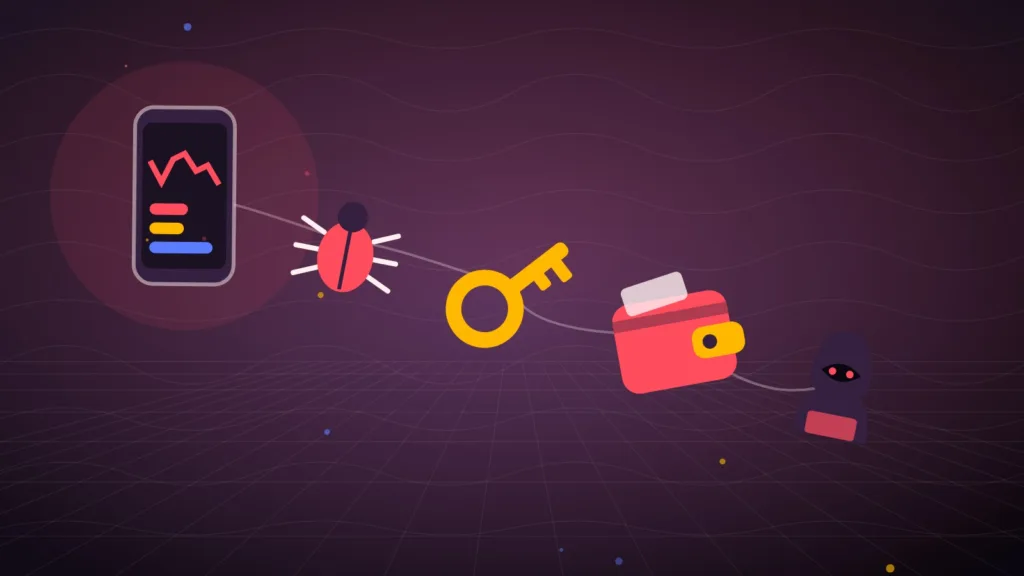
How the kits reached ordinary websites in November
Both kits need a victim to open a booby-trapped page in Safari or another iPhone browser. On 16 November, an attacker abused a flaw in the signup flow of Optimizely Web Experimentation to write code into customer projects, and the code ran on the websites of the companies using it. Our report on the hijacked Optimizely scripts covered the address swapper it carried, which hit 178 organisations including Ledger’s website.
The iPhone part came out two days later. In a Zscaler ThreatLabz analysis of 18 November, the injected loader checked for iOS and iPadOS and chose a path by version: Coruna for iOS 13 to 17, DarkSword for iOS 18.x, and a separate branch for iOS 26. ThreatLabz counted more than 450 domains and more than 3,000 URLs serving the script. It also found the code swapping wallet addresses for eight coins (bitcoin, ether, TRX, SOL, LTC, TON, BCH and DOGE) and, in later versions, skimming card numbers typed into page forms.
Zscaler did not confirm a single iPhone compromised this way. It wrote only that the script reportedly attempted to load the kits for iPhone and iPad visitors. Optimizely said it blocked the vulnerable path, removed the injected code, ended active sessions and revoked tokens. Earlier this month, Coindaro also reported Bitquery’s trace of $4.06 million drained from 365 TRON wallets, where the iPhone link rested on one victim, and the MoldyRoost ads that hunt for seed phrases in Notes and photos.
| Kit | iOS versions targeted | Documented by | Closed by |
|---|---|---|---|
| Coruna (5 chains, 23 exploits) | 13.0 to 17.2.1 | GTIG, 3 March 2026 | All flaws in Google’s table fixed by iOS 17.5; not effective on the latest iOS, per Google |
| DarkSword (6 vulnerabilities) | 18.4 to 18.7 | GTIG with Lookout and iVerify, 18 March 2026 | Five flaws fixed by iOS 18.7.3, all six by iOS 26.3; iVerify advises 18.7.6 or 26.3.1 |
| Optimizely loader (delivery, not an exploit) | Routed iOS 13 to 18.x to the kits; separate iOS 26 branch | Zscaler ThreatLabz, 18 November 2026 | Optimizely fix; on the phone, the same iOS updates |
| Apple’s latest releases | iOS 27.2.1, 26.7.3 (iPhone 11 and later), 18.7.12 (iPhone XS, XS Max, XR) | Apple security releases page | Released 9 November 2026 |
What neither warning says
Durov spoke of hacking on a large scale. Neither he nor Telegram has published a number of victims, a list of affected countries or the vulnerability behind the claim. CZ named a version range and a list of apps, but no new flaw and no losses. Apple’s security releases page lists iOS 27.2.1, iOS 26.7.3 and iOS 18.7.12, all of 9 November. None of the three advisories carries Apple’s usual note that a flaw may have been exploited, and none lists a WebKit fix. Apple has not published a statement about the two warnings.
So there is no sign of a new zero-day. The most likely reading, and the one Talk Android and Bitcoin.com News make, is that both companies are using in-app alerts to push laggards off versions that public kits still break. That reading is still an inference. CZ’s own words, “where OS detection is possible”, also concede that some apps and sites cannot see which version a phone runs.
Two loose ends remain. Zscaler found an iOS 26 branch in the Optimizely loader, and nobody has shown that it can break iOS 26. Bitcoin.com News also cites a claim made in September by 23pds, the chief information security officer of SlowMist, that the exploit could have evolved to reach newer iOS versions; security firms have not confirmed it.
What to do: install iOS 18.7.12, 26.7.3 or 27.2.1, and keep seeds off the phone
Updating the wallet app does not fix the operating system underneath it. The kits attack Safari’s engine and the iOS kernel, so only an iOS update closes them. Google’s advice for both kits is the same: run the latest iOS your device supports, and turn on Lockdown Mode if you cannot.
- Open Settings, then General, then Software Update, and install what is offered. Check the version under Settings, General, About.
- On an iPhone 11 or later, iOS 26.7.3 or iOS 27.2.1 (both of 9 November) is well past the 26.3 release that patched all six DarkSword flaws.
- On an iPhone XS, XS Max or XR, which cannot run iOS 26, install iOS 18.7.12. In March, iVerify advised at least iOS 18.7.6 or 26.3.1 to close the flaws in both chains.
- If an older iPhone cannot reach a supported release, turn on Lockdown Mode (Settings, Privacy and Security) and stop using that phone for a wallet.
- Never keep a seed phrase in Notes, in photos or in a screenshot: Coruna scans for exactly that. Paper or metal, offline, is the standard.
- Open crypto links only from addresses you typed or bookmarked; the November delivery went through legitimate websites, so a trusted domain is not proof on its own.
Our guide to backing up a seed phrase explains offline storage, and if funds have already moved, what to do in the first hour after a wallet is hacked covers the steps that still help.
For now, nothing on Apple’s page is newer than the releases of 9 November. Telegram has not said which iOS versions trigger its alert, and the Binance-group apps start from CZ’s range of 18.4 to 18.7.