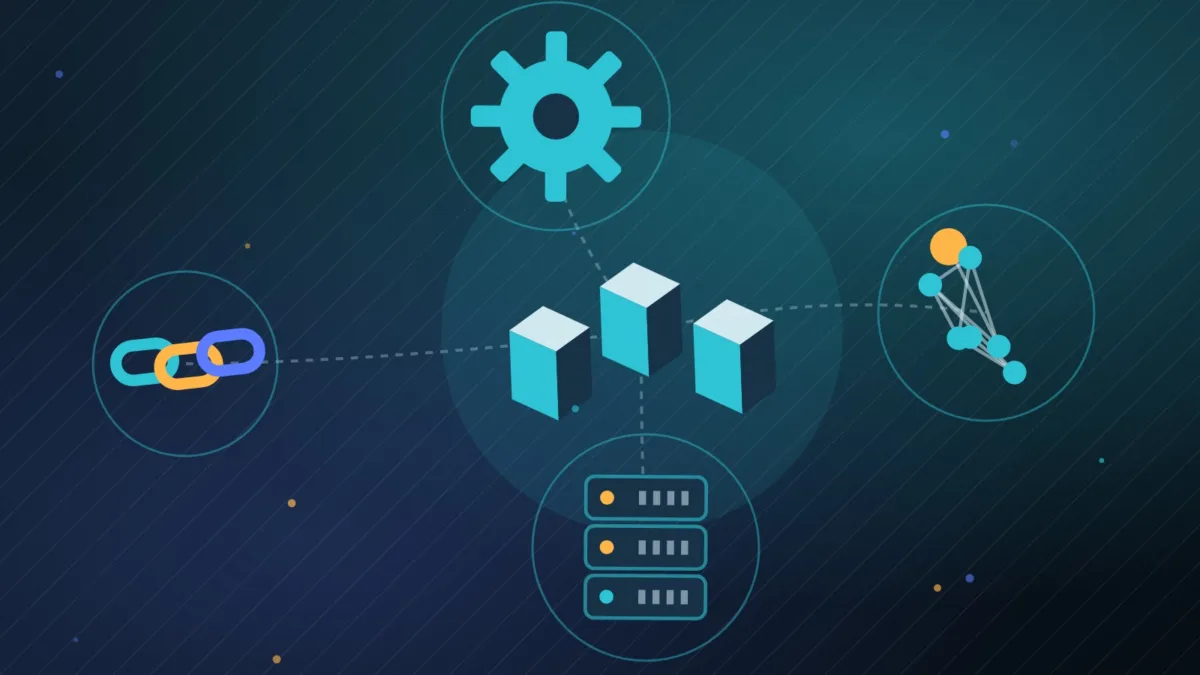
A single blockchain, where users swap tokens directly from their own wallets without handing custody of their funds to a company.">swap on a rollup built for one trading app can touch three networks. The app’s sequencer, a server run by one company, puts the order in line and executes it. The batch of transaction data is posted to Celestia or to Ethereum blobs. A claim or a proof about the new state lands in a contract on Ethereum, which is where any dispute would be judged. Four jobs, up to three networks, one click. Make the same swap on Solana and one network does all four.
That split is what a modular blockchain is: a chain that hands some of its core jobs to other networks instead of doing everything on one set of validators. The opposite, a chain that does it all itself, is called monolithic, or “integrated” in the vocabulary Solana’s developers prefer. Push the idea one step further and you get the app-chain, a whole blockchain built for a single application. Which design wins is the argument running through this lesson, and as of November 2026 the evidence points both ways.
The previous lesson, on state channels and how they move payments off-chain, ended with the idea of splitting a blockchain into specialised layers that anyone can use. This is that lesson. By the end you should be able to say, for any chain you use, who executes your transaction, who settles it, who orders it and where its data lives, and what each answer means for your money.
Four jobs inside every blockchain: execution, settlement, ordering and data
Every blockchain does four things, whatever its marketing says. Bitcoin does all four with one set of nodes, and so did Ethereum until rollups arrived. A modular design starts by asking which of the four could be done somewhere else.
Execution: running the transactions
Execution means taking transactions and computing the new state: balances, contract storage, open positions. On Ethereum mainnet every full node re-runs every transaction, which is why the chain’s throughput is capped by what an ordinary machine can handle. On a rollup, execution happens on the rollup’s own nodes. Ethereum sees only the result and the data needed to check it.
Settlement: where disputes and proofs are judged
Settlement is the court of last resort. It is the layer that decides which state is final when someone challenges it, that verifies a validity proof, and that holds the bridge contract you use to leave. For most rollups the court is Ethereum: an optimistic rollup’s fault proofs and a ZK rollup’s validity proofs are both checked there.
A sovereign rollup is the exception. It settles nothing on another chain; its own nodes decide which chain is valid, and it uses a data layer only to publish its data. That gives it full control over upgrades and no bridge contract on Ethereum to fall back on.
Ordering and consensus: who decides the sequence
Ordering decides which transaction comes first. On a monolithic chain the validators’ consensus protocol does it. On almost every rollup today one sequencer does it, and Ethereum only pins that order down later, through the data the rollup posts.
The words get blurred in diagrams. “Consensus” on a modular chart usually means agreeing on the order and on the data, not executing anything. Whoever orders transactions also collects MEV, the value that comes from placing trades in a profitable sequence, which makes ordering a business question as much as a technical one.
Data availability: proof that the data was published
Data availability, usually shortened to DA, is the least intuitive job and the one that made modular designs possible. It does not mean storing data forever. It means guaranteeing that, when a block was produced, all of its data was published, so that anyone could download it, rebuild the state and, if needed, prove fraud or force an exit. Ethereum blobs, for example, are pruned after about 18 days, as our lesson on blobs and EIP-4844 explains. A rollup whose data is withheld is a rollup whose users cannot prove what they own.
A layer 2 rollup is the simplest modular chain: it keeps execution and, usually, ordering, and outsources settlement and data availability to Ethereum. Everything else in this lesson is a variation on which of the four jobs a chain keeps and which it rents.
Where the modular blockchain idea comes from: LazyLedger and Ethereum’s 2020 turn
The idea has a paper and a date. On 22 May 2019 Mustafa Al-Bassam posted “LazyLedger: A Distributed Data Availability Ledger With Client-Side Smart Contracts” on arXiv, revised for the last time on 8 June 2019. Its proposal was radical for the time: a blockchain optimised for “solely ordering and guaranteeing the availability of transaction data”. The chain itself would execute nothing. Each application’s users would run the transactions they care about on their own machines, and the workload of one app would barely grow when another app on the same chain got busy.
The technique that makes this workable is data availability sampling. A block is first extended with erasure coding, which adds redundant pieces so that the full data can be rebuilt from only part of it. A producer who wants to hide data must then withhold a large share of the pieces, and a light node that downloads a few random pieces will notice with high probability. Checking a block becomes a probabilistic test that costs far less than downloading it. A later lesson on data availability goes into the maths of sampling.
The project built on that paper took the name Celestia. Its mainnet produced block 1 on 31 October 2023 at 14:00 UTC, according to the Celenium explorer.
Ethereum reached a similar place from the other side. On 2 October 2020 Vitalik Buterin posted “A rollup-centric Ethereum roadmap” on the Ethereum Magicians forum. He wrote that the ecosystem was likely to go “all-in on rollups” as its scaling strategy for the near and mid term, and that sharding data availability was much safer than sharding EVM computation. In plain terms, Ethereum would stop trying to execute everything itself and would become the settlement and data layer for rollups that execute elsewhere.
Four years later, in “Possible futures of the Ethereum protocol, part 2: The Surge” (17 October 2024), Buterin set the goal at 100,000 transactions per second on rollups. The two documents split the field. Celestia built a chain that only orders data and keeps it available. Ethereum kept settlement and data, and pushed execution out. Both bet that the scarce resource is space for data, not computation.
Data availability layers in November 2026
A rollup or app-chain choosing where to publish its data in November 2026 has four main options. They differ less in speed than in whom you have to trust.
Ethereum blobs: the default by value
Ethereum has been a DA layer since blobs went live with the Dencun upgrade on 13 March 2024. Since 7 January 2026 a block targets 14 blobs and can carry 21, each of 128 KiB: about 1.75 MiB of rollup data every 12 seconds at target, 2.6 MiB at most. Since the Fusaka upgrade of 3 December 2025, PeerDAS lets Ethereum nodes sample columns of blob data instead of downloading all of it, the LazyLedger idea applied to Ethereum.
By value, nothing comes close. According to the blobs lesson’s reading of ETHBEAT (formerly L2BEAT) on 12 November 2026, 39 of 80 active L2s posted their data to blobs and held $30.9bn of the $35.9bn they secured, or 86.1%. The others relied on custom DA (14 chains), a data availability committee (9), Celestia (7), EigenDA (5, plus 2 with a verifier) or plain calldata (3). A chain that publishes outside Ethereum is what ETHBEAT and our guide to ZK rollups and validiums treat as a weaker category, because Ethereum can no longer vouch for the data.
Celestia: launched in October 2023, with room it does not use
Celestia is the purest modular chain. It orders blobs of data and guarantees they were published, with its own proof-of-stake validators, its TIA token and light nodes that sample. It executes nothing on behalf of the rollups that use it.
Its capacity has grown much faster than its use. The Matcha upgrade, activated on 24 November 2025 at block 8,662,012, prepared the network for blocks of up to 128 MB, as its announcement put it. The parameter read on the Celenium indexer on 15 November 2026 allows 32 MiB per block, with a block every 2.85 seconds on average over the last 100 blocks: about 11.8 MB per second of standard capacity. In that same sample of the last 100 blocks, taken at 09:40 UTC, blocks carried about 70 KB of rollup data each, with a peak of 423 KB, by Coindaro’s count from the indexer’s block data. The data layer built to serve many chains was running at well under 1% of its standard capacity that morning. One sample is not a trend, but it shows how far use is from the headline figures.
| Celestia (Celenium indexer, 15 November 2026, 09:45 UTC) | Value |
|---|---|
| First block | 31 October 2023, 14:00 UTC |
| Block height | 15,912,164 |
| Average block time (last 100 blocks) | about 2.85 seconds |
| Maximum block size (protocol parameter) | 32 MiB (33,554,432 bytes) |
| Rollup data per block (last 100 blocks at 09:40 UTC, Coindaro’s count) | about 70 KB on average, 423 KB at most |
| Rollup data published since launch | about 4.7 TB |
| Transactions since launch | 81,594,460 |
| Namespaces (separate data lanes used by rollups and apps) | 1,104 |
Celestia keeps adding capacity anyway. Its blog announced on 1 October 2026 that Fibre, a second high-throughput lane, had reached 3 Tb/s in a benchmark, and in July 2026 Celestia Labs announced it had acquired Sovereign Labs. Benchmarks are not demand. The upgrade history also shows the cost of moving fast: version 7, Hibiscus, was skipped on mainnet because of a bug found after it went live on the test network, according to Celestia’s upgrade page.
EigenDA and Avail: a restaked committee and a sampling chain
EigenDA takes a different route. Its V2 went live on mainnet on 30 July 2025, and EigenLabs says it runs at 100 MB/s. “EigenDA is the fastest DA solution with V2 now live,” the company wrote that day. That is the vendor’s claim, not an independent measurement; the post itself gives a peak of 124 MB/s in a load test on the Holesky test network, with Fuel Ignition and Aevo as the first live users. The guarantee rests on a committee: operators who restake ETH through EigenLayer attest that they hold the data, and their stake is what is at risk if they lie. Our lesson on restaking and EigenLayer explains how that security is pooled and slashed.
Avail sits closer to Celestia. Its DA mainnet launched with the AVAIL token on 23 July 2024, as The Block reported that day. Light clients check blocks by combining KZG commitments, a compact cryptographic fingerprint of the data, with data availability sampling, according to co-founder Prabal Banerjee. AVAIL pays the DA fees and is staked to secure the network.
| DA layer | Live since | Who guarantees the data | Stated capacity | Users (dated) |
|---|---|---|---|---|
| Ethereum blobs | 13 March 2024 (PeerDAS since 3 December 2025) | Ethereum validators; nodes sample columns | target 14, max 21 blobs of 128 KiB per 12 s block (since 7 January 2026) | 39 of 80 L2s, 86.1% of value secured (ETHBEAT, 12 November 2026) |
| Celestia | 31 October 2023 | own proof-of-stake chain (TIA); light nodes sample | 32 MiB per block (parameter, 15 November 2026) | 7 Ethereum L2s tracked by ETHBEAT (12 November 2026), plus rollups outside Ethereum |
| EigenDA | V2: 30 July 2025 | committee of operators restaking ETH via EigenLayer | 100 MB/s (EigenLabs claim, 30 July 2025) | 5 L2s, plus 2 with a verifier (ETHBEAT, 12 November 2026) |
| Avail | 23 July 2024 | own proof-of-stake chain (AVAIL); KZG commitments and sampling | not published in the sources used | not counted separately by ETHBEAT |
The capacity column compares unlike things: a live protocol parameter for Ethereum and Celestia, a vendor figure for EigenDA. What the user column shows is simpler. Most value sits on the layer with the biggest validator set, even though it is the most expensive per byte.
App-chains: one blockchain for one application
An app-chain reverses the question. Instead of renting layers for many apps, a team builds a chain whose only customer is its own application. It picks its validators, its fee token, its block time and its ordering rules. In November 2026 a team has several toolkits to choose from, and they differ mostly on where the chain’s security comes from.
Cosmos SDK and IBC: dYdX put its order book on its own chain
The Cosmos SDK is a toolkit for building a standalone layer 1 with CometBFT consensus, and IBC is the protocol that lets those chains pass messages and tokens to each other. The best-known app-chain built with it is dYdX. Its chain created its genesis block at 1 p.m. EST on 26 October 2023, with more than 60 validators being onboarded, The Block reported. dYdX’s documentation describes the protocol as an L1 blockchain built on CometBFT and the Cosmos SDK.
The design shows why an app-chain can do what a shared chain cannot. On dYdX, validators keep orders in an in-memory order book that is not committed to consensus. A trader’s order is gossiped between validators, the block proposer matches it and includes the trade in its block, and the block is final once validators holding two-thirds of the stake approve it. Placing and cancelling orders all day would be very expensive on a general-purpose chain where every order pays gas. On its own chain, dYdX writes only the matched trades.
Osmosis, a decentralised exchange that also runs as its own Cosmos chain, shows the other side of sovereignty. In March 2026 a proposal nicknamed COSMOSIS suggested merging Osmosis into the Cosmos Hub. The plan needed two yes votes, one on each chain, and it got only one. On Osmosis, proposal 1007 (voting 9 to 14 April 2026) passed, with 66.75% of votes cast in favour, according to the chain’s governance records. On the Cosmos Hub, proposal 1029 (9 to 16 April 2026) was rejected: 45.82% voted no, 37.87% yes and 16.27% abstained, on a turnout of 43.75%, according to the Hub’s on-chain record. So the merger did not happen. On 17 April Osmosis said it would continue as an independent chain, crypto news outlets reported. A chain that pays for its own security has a recurring bill, and in 2026 a majority of Osmosis’s voting stake was ready to give that up.
Polkadot: from slot auctions to coretime
Polkadot takes the opposite view on security. Its app-chains, called parachains, do not bring their own validator set: the relay chain’s validators check their blocks, so every parachain shares one security budget. For years a project won a parachain slot in an auction and locked DOT for the length of the lease.
That ended on 19 September 2024, when agile coretime went live and, as the Polkadot Digest of that day put it, ended the era of parachain lease auctions. A chain now buys time on the relay chain’s cores. Bulk coretime comes in fixed regions of 28 days, represented by an NFT that can be split, interlaced and resold; on-demand coretime is paid block by block. Both are paid in DOT, which turns a slot won once into a running cost that a quiet chain can scale down.
Avalanche L1s, formerly subnets
Avalanche’s app-chains used to be called subnets, and every subnet validator also had to validate Avalanche’s Primary Network and stake 2,000 AVAX. ACP-77, “Reinventing Subnets”, is now activated and removed both requirements. Validators of what Avalanche now calls an Avalanche L1 only need to sync the P-Chain, and pay a continuous fee instead, at least 512 nAVAX per second, about 1.33 AVAX a month per validator, while the number of active L1 validators stays at or below the target of 10,000. Avalanche’s own documentation now defines its mainnet as the Primary Network plus all deployed Avalanche L1s.
The trade-off sits between the two previous models. An Avalanche L1 brings its own validators, like a Cosmos chain, but registers them with a shared chain that keeps track of who they are.
Rollup app-chains: OP Stack, Arbitrum chains, ZK Stack and Agglayer CDK
The fourth route is to launch a rollup for one application from a ready-made stack, and settle on Ethereum or on another layer 2. ETHBEAT’s data, read on 15 November 2026 at about 10:00 UTC, lists 80 active L2s and 10 L3s, with $33.89bn of value secured on the L2s.
| Stack label on ETHBEAT (15 November 2026, about 10:00 UTC) | Active L2s | Value secured |
|---|---|---|
| OP Stack (still includes Base, which left on 18 February 2026) | 36 | $17.29bn |
| Arbitrum (Nitro chains) | 10 | $10.46bn |
| SN Stack (Starknet) | 2 | $0.32bn |
| Agglayer CDK and OP Stack mixes | 2 | $0.25bn |
| ZK Stack (ZKsync) | 7 | $0.24bn |
| Agglayer CDK (Polygon) | 6 | $0.04bn |
| No stack label | 14 | $5.27bn |
| Total | 80 (plus 10 L3s) | $33.89bn |
One caveat changes how to read that table. ETHBEAT still tags Base as an OP Stack chain, but Base left the OP Stack and the Superchain on 18 February 2026, moving to its own stack built from that code and ending the 15% revenue share it paid. Base alone held about $13.8bn on 11 November 2026, so most of the value in the OP Stack row now belongs to a chain that has left that family. Base today runs its own proof system combining a trusted execution environment and ZK proofs.
Arbitrum’s documentation describes its chains as Nitro chains that can choose to post data to Ethereum as a full rollup, to a committee under its AnyTrust option, or to an external DA layer, and can use a custom ERC-20 token for gas. Seven of the ten L3s that ETHBEAT lists, chains that settle on another L2 rather than on Ethereum, sit on top of Arbitrum One; ApeChain, Xai and EDU Chain are among them. Companies such as Conduit, Caldera and Gelato sell rollup-as-a-service: they launch and operate a rollup for a client, for a fee, so that a game or an exchange does not have to run its own infrastructure.
Chains also switch category. Ronin, Sky Mavis’s gaming chain, moved to an OP Stack chain posting data to EigenDA in May 2026, a move our comparison of sidechains and rollups follows in detail.
Initia: an L1 built to host rollups
Initia starts from the other end: a layer 1 designed from day one to coordinate a family of app-specific rollups, which it calls interwoven rollups. Its mainnet went live on 24 April 2025, according to the staking company Figment and Blockworks’ token data. The rollups are built with its OPinit stack and can run an EVM, MoveVM or WasmVM environment, so a team can pick the programming model without leaving the family.
| Framework | Where security comes from | Dated fact | Example |
|---|---|---|---|
| Cosmos SDK + IBC | the chain’s own validators and token | dYdX Chain genesis 26 October 2023 | dYdX, Osmosis |
| Polkadot parachain | the relay chain’s shared validators | agile coretime live 19 September 2024 | parachains renting cores in DOT |
| Avalanche L1 | its own validators, registered on the P-Chain | ACP-77 activated; fee from 512 nAVAX per second per validator | Avalanche L1s (formerly subnets) |
| OP Stack rollup | Ethereum for settlement; data on blobs or elsewhere | 36 L2s under that label on ETHBEAT, 15 November 2026 (the count still includes Base) | OP Mainnet; Ronin since May 2026 |
| Arbitrum chain | Ethereum or a parent L2; rollup, AnyTrust or external DA | 10 L2s and 7 L3s on Arbitrum One, 15 November 2026 | ApeChain, Xai, EDU Chain |
| ZK Stack, Agglayer CDK | Ethereum, through validity proofs | 7 and 6 L2s on ETHBEAT, 15 November 2026 | chains of the ZKsync and Polygon families |
| Initia | the Initia L1 that coordinates its rollups | mainnet 24 April 2025 | interwoven rollups built with OPinit |
Shared sequencing: Espresso is running, Astria shut down
Separate rollups have a problem that a monolithic chain does not. Each has its own sequencer, so no one can guarantee that a trade on one rollup and a trade on another happen together or not at all. Shared sequencing proposes one ordering service for many rollups at once, which would make that kind of cross-rollup atomicity possible and remove the single-company sequencer.
Espresso is the project still running. Its changelog dates its first mainnet to October 2024, with 20 node operators running 100 nodes, and the move to permissionless delegated proof of stake on Ethereum mainnet to 4 March 2026. Earlier test networks integrated demo versions of Arbitrum Nitro and the OP Stack. The changelog does not list major production rollups that hand their ordering to Espresso.
Astria is the cautionary tale. The Celestia-based shared sequencer network was intentionally halted at block 15,360,577, recording its last block on Monday 1 December 2025, The Block reported the next day. Co-founder Josh Bowen had said in mid-November that the shutdown was coming. Astria had raised $18 million, and over 2025 it had already stopped developing its Flame EVM and shut down its Celestia validator, according to the same report.
The lesson is commercial more than technical. Shared sequencing asks a rollup to hand over the job that earns it sequencer fees and MEV. Astria’s end shows how hard that is to sell.
The case for app-chains: sovereignty, fees and MEV kept at home
The arguments for a modular blockchain or an app-chain come down to control and cost.
Fees stay at home. On a shared chain, the gas an app’s users pay goes to that chain’s validators. On its own chain, the app’s own validators and stakers collect it, and so does the value of ordering. A rollup that runs its own sequencer keeps its sequencer margin and can set its own policy on MEV, for instance by offering private order flow or first-come ordering.
The chain can be shaped around the app. dYdX’s off-consensus order book is the clearest example. Arbitrum chains can make users pay gas in the app’s own token. An app-chain upgrades on its own schedule, without waiting for a shared chain’s governance.
Data is cheap. With Celestia’s standard lane mostly empty, and Ethereum’s blob target raised to 14 per block, publishing data is no longer the main cost of running a chain. That changes the maths for small projects that a few years ago could not afford their own blockspace.
Base’s decision in February 2026 makes the same point from the top: the largest chain that had been built on the OP Stack left it, with its own stack and no more revenue share for the Superchain.
The case against: fragmented liquidity, bridges and thin security budgets
The costs are real, and by late 2026 they explain several retreats.
Liquidity splits. The same dollar stablecoin on ten chains means ten pools, ten prices and ten places where a large order moves the market. A user who wants the best price must first move money to where it is. Each app-chain also has its own gas token, so the first step on a new chain is often buying a token you do not want just to pay fees.
Every move is a bridge. Funds that leave one chain for another cross a bridge contract or a messaging protocol, and bridges have been the target of some of the largest thefts in crypto, from Ronin to Wormhole and Nomad, as our review of DeFi hacks and exploits recounts. Intent-based routes cut the waiting time but add a solver you rely on to deliver; our guide to cross-chain liquidity, bridges and intents explains the designs. A later lesson on bridges and interoperability goes further.

Security budgets get thin. A chain secured by its own token is as safe as the value staked behind it, and a small app-chain’s stake can be worth a fraction of what an attacker might gain. Polkadot’s shared validators and Ethereum rollups are two answers, but a rollup only inherits Ethereum’s protection if its proofs and exit routes work. If the sequencer stops, users of a rollup can usually force a transaction through Ethereum, with a delay that ETHBEAT’s risk notes put at up to 12 hours on some chains.
The retreats tell the same story. Astria shut its sequencer network down. Osmosis’s stakers voted to fold their chain into the Cosmos Hub, and only the Hub’s no vote kept it independent. Ronin changed category twice in 2026. None of that proves app-chains fail; it shows that running a chain is a permanent expense that the app has to earn back.
Solana’s answer: one integrated chain
Solana makes the monolithic case in its strongest form. Its developers call the design integrated: one global state, one validator set, every application able to call every other in the same block, and no bridge between them. Scaling, in that view, comes from faster hardware, more bandwidth and better software, not from splitting the chain.
The chain changed underneath that argument this autumn. On 21 October 2026 Solana switched to Alpenglow consensus, with its Votor component live (Rotor, the data-propagation part, is not yet) and 200-millisecond slots under SIMD-0525. Proof of History and Tower BFT, the mechanisms that long defined Solana, now belong to its past.
The price of integration is paid by validators, who need much more powerful machines and connections than an Ethereum node, and by anyone who wants to verify the chain from a laptop. The modular camp has not stood still either: Base’s Denim upgrade brought 200-millisecond blocks on 5 November 2026. On latency, the two designs are converging; the difference left is where trust and composability sit.
Monolithic, modular, app-chain: the comparison
| Monolithic (Solana) | Modular rollup on Ethereum | Sovereign app-chain (Cosmos SDK) | |
|---|---|---|---|
| Who executes | all validators | the rollup’s sequencer and nodes | the chain’s validators |
| Who settles | the same chain | contracts on Ethereum | the chain itself |
| Who orders | the validator set (a rotating leader) | usually one sequencer | the chain’s validator set |
| Where the data lives | the same chain | Ethereum blobs, Celestia, EigenDA or a committee | the chain itself |
| Composability | one state, atomic across apps | inside the rollup; across rollups only through bridges | through IBC or bridges |
| Security budget | the chain’s own stake | Ethereum’s, for state, if proofs and exits work | its own token’s stake |
| If the operator fails | the validator set must recover | force inclusion through Ethereum, with a delay | no outside fallback |
What a modular blockchain means for your money
Before moving funds to a chain, ask five questions. The answers are usually on the chain’s documentation and on ETHBEAT’s page for it.
- Who orders my transaction: one company’s sequencer, a validator set, or a shared sequencer?
- Where is the data published: Ethereum blobs, Celestia, EigenDA, Avail or a committee of named members?
- How do I leave if the operator stops: is there a force-inclusion route and a working proof system, and how long does a withdrawal take?
- Which bridge will I use to get in and out, and who can upgrade its contracts?
- Which token pays for gas, and do I have to buy it before I can do anything?
Use small test amounts on any chain you have not used before, and check the chain ID in your wallet against the project’s official documentation. The next lesson in this path shows step by step how to bridge to a layer 2 safely, from the canonical bridge to a direct withdrawal from an exchange.
Taxes and rules for US and UK users
Regulators do not treat a modular chain or an app-chain as a category of its own; the usual rules on digital assets apply to what you do on it. Two points matter more on app-chains, because they run on their own token and often ask users to stake it.
In the United States, the IRS treats digital assets as property, so swapping one token for another, including the gas token of a new chain, is generally a taxable disposition. Staking rewards are income: Revenue Ruling 2023-14 of 31 July 2023 holds that a cash-method taxpayer who stakes and receives validation rewards includes their fair market value in gross income in the year they gain dominion and control over them. In the United Kingdom, the FCA classes cryptoassets as high risk, and HMRC taxes disposals under capital gains rules. Keep a record of every bridge and swap with its date and dollar or pound value; on ten chains, that record is the hard part.